

7-8 May, 2026
LMTA Central Building (Gedimino ave. 42, Vilnius)
The symposium is dedicated to the entanglements between posthuman forms of knowledge and contemporary artistic practices. Posthumanism, as defined by Rosi Braidotti, is a critical methodology aiming to question both humanism and anthropocentrism (Braidotti 2013, 2018; Braidotti and Bignall 2019). First, posthumanism can be seen as a critique of the humanist model of ‘Man’, which is based on the project of the Enlightenment and expresses ‘the Eurocentric, masculinist universalism that is still operative in the most knowledge production scientific systems’ (Braidotti and Bignall 2019: 2). By contrast, posthumanism offers partial and perspectival ‘situated knowledges’, which take into account feminism, gender theory, postcolonialism, decolonial theory and emerging indigenous philosophies. Second, posthumanism can be seen as a critique of anthropocentrism and human exceptionalism, based on species hierarchy and the subjection and exclusion of nonhuman others. Posthumanism raises ‘the question of the animal’ and asks what place animals take in our all-too-human ontology (Derrida 2008; Despret 2016). It challenges the rigid boundaries between human and nonhuman animals, demonstrating that they share capacities such as sentience, affectivity, inventiveness, memory, and cognition. In this respect, posthumanism can be seen as an inclusive way of thinking that attempts to conceptualise what is ‘more-than-human’.
Such a conceptualisation is not an easy task. As Cary Wolfe suggests, “when we talk about posthumanism, we are not just talking about a thematics of the decentering of the human […]; rather […] we are talking about how thinking confronts that thematics, what thought has to become in the face of those challenges” (Wolfe 2010: xvi). This implies the need to rethink our research methodologies and the necessity to redefine human subjectivity in such a way that it would include multiple modes of existence. As Wolfe explains, “the ‘human’ can no longer be considered either the origin or the end of thought, and in at least two senses. First, the ‘human’ is not an explanans but an explanandum, not an explanation but that which needs to be explained. (…) Moreover – and more radically – not only is the line between human and nonhuman impossible to definitively draw with regard to the binding together of neurophysiology, cognitive states and symbolic behaviours, the line between ‘inside’ and ‘outside’, ‘brain’ and ‘mind’, is also impossible to draw definitively” (Wolfe 2018: 357–8).
In other words, posthumanism is a new way of thinking, oriented towards the multiplicity of connections between inorganic and organic, human and nonhuman, human and technological beings. Besides the conventional forms of knowledge, posthuman knowledge takes into account affect and affectivity (Brian Massumi, Patricia Clough), nonconscious cognition (Antonio Damasio, N. Katherine Hayles), relationality (Bruno Latour, Karen Barad), materialism (Jane Bennett), speculative fabulation (Donna Haraway), and perspectivism (Déborah Danowski, Eduardo Viveiros de Castro). These different approaches create a kind of “patchy posthumanism” which is heterogeneous, discontinuous, and provisional. It leaves us in a permanent discontent because it does not provide a unified vision of the world, and is not comforting or reassuring.
However, this “patchy posthumanism” opens the way not only for new fields of knowledge but also initiates new, non-representational ways of artistic expression. The symposium encourages examining those artistic practices which are based on experimentation, research, and collaboration. As Justyna Stępień points out, contemporary artists “apply non-representational methods that move towards relations, actions, and events (…) to apprehend the structures of change and dynamism of socio-material entities, reinventing human practices of care and concern. These artistic expressions are embodied and embedded, experimental in their nature, unsettling, rupturing, rather than reporting or representing” (Stępień 2022: 6). In other words, to entangle with posthuman or more-than-human entities, artists and theoreticians have to invent new modes of artistic practices, which would destabilise human subjectivity through hybrid, experimental, performative, or biomediated encounters.
References:
- Braidotti, Rosi (2013). „The Posthuman“. Cambridge: Polity Press.
- Braidotti, Rosi (2018) „A Theoretical Framework for the Critical Posthumanities“. Theory, Culture & Society, Special Issue: „Transversal Posthumanities“, pp. 1–31.
- Braidotti, Rosi and Simone Bignall (eds) (2019). „Posthuman Ecologies: Complexity and Process After Deleuze“. New York, London: Rowman and Littlefield.
- Derrida Jacques (2008). „The Animal That Therefore I Am“, trans. David Wills, New York: Fordham University Press.
- Despret, Vinciane (2016). „What Would Animals Say If We Asked the Right Questions?“, trans. Brett Buchanan, Minneapolis: University of Minnesota Press.
- Stępień, Justyna. (2022). „Posthuman and Nonhuman Entanglements in Contemporary Art and the Body“. New York and London: Routledge.
- Wolfe, Carey (2010). „What Is Posthumanism?“. Minneapolis: University of Minnesota Press.
- Wolfe, Carey (2018). „‘Posthumanism’, in Rosi Braidotti and Maria Hlavajova“ (eds). Posthuman Glossary. New York, London: Bloomsbury, pp. 356–9.
Keynote abstracts:
Justyna Stępień
Thinking with and for More/than/human World in Artistic Practices
This lecture examines how to think and create with and for the Earth amid today’s polycrisis. It introduces “more/than/human investigation,” an inclusive approach that recognises difference across multispecies relations, race, and sexuality within the complex web connecting self and others. From this perspective, knowledge is not produced solely by humans; it emerges through shared processes of thinking and knowing with the more/than/human world and its ongoing differentiation. Building on this understanding, the lecture focuses on artistic practices, showing how artists engage with and work for the more/than/human world rather than merely representing it. Drawing on Karen Barad’s work, it frames the artistic process as a mode of reshaping knowledge through material and embodied forms of engagement. This approach weaves together ethics, ways of being, and ways of knowing, highlighting their inseparability. Within this framework, ethical action involves entering into relationships with multiple others and cultivating shared understandings of our interconnected existence. As the lecture will demonstrate, such practices of care extend beyond representation: they actively participate in shaping the world by proposing new ways of working, developing innovative methods, and articulating ethical perspectives that influence how we relate to—and take responsibility for—the more/than/human world.
Justyna Stępień is an Associate Professor in Literary and Cultural Studies at the Department of British Literature and Culture at the University of Lodz. She co-founded the Posthumanities Research Centre, University of Lodz (Poland).Her research engages with ways of conceiving ethical and political action in contemporary art, analysed through the methodological perspectives of feminist theories, new materialisms, and critical posthumanism. She is the author of Posthuman and Nonhuman Entanglements in Contemporary Art and the Body (Routledge, 2022), which explores how art can conceptualise the material boundaries of entangled beings in the Anthropocene.
Marietta Radomska
Non/Living Matters: On Posthumanising Art Practice
Posthumanism as a philosophical strand and the posthumanities as a field of knowledge creation have emerged against the backdrop of planetary environmental disruption (or crises), on the one hand, and a rapid technological development, intervening in both life itself and the mind, on the other. The ‘post-’ has gestured towards a form of rewriting (Lyotard 1991) of the humanist legacy.
Artists have not remained indifferent. Developing since the 1990s, bioart – a form of artistic practices involving the use of biological matter and the employment of scientific methods, protocols, and tools – has challenged the distinction between representation and presentation (Mitchell 2010); the boundaries of art, science, and technology (daCosta and Philip 2010; Reichle 2009); and the very cultural and philosophical framing of life and the body (Kac 2006; Zurr and Catts 2023).
Drawing on several examples of contemporary artists, from the iconic duo of The Tissue Culture & Art Project (AU), through the works of Svenja Kratz (AU), to installations by Margherita Pevere (IT/DE), among others, this lecture will zoom in on ‘the non/living’ (Radomska 2016) as a material and conceptual node, entangling processes of living and dying, growth and decay. The non/living exposes not only the conceptual and material blurriness of life and death, so central in bioartworks, but also some of the key problematic of posthumanism(s): human subjectivity, ‘control’, and relation to nonhuman others; the authority of technoscience; and the more-than-human ethical enquiry.
References:
Da Costa, B. and K. Philip, eds. 2010. Tactical Biopolitics: Art, Activism, and Technoscience. Cambridge, MA: The MIT Press.
Kac, E, ed. 2006. Signs of Life. Cambridge, MA: The MIT Press.
Lyotard, F. 1991. The Inhuman. Cambridge: Polity Press.
Mitchell, R. 2010. Bioart and the Vitality of Media. Seattle and London: University of Washington Press.
Radomska, M. 2016. Uncontainable Life: A Biophilosophy of Bioart. Linköping: Linköping University Press.
Reichle, I. 2009. Art in the Age of Technoscience: Genetic Engineering, Robotics, and Artificial Life in Contemporary Art. Cham: Springer.
Zurr, I., and O. Catts. 2023. Tissues, Cultures, Art. Cham: Palgrave.
Marietta Radomska, PhD, Docent, is Associate Professor of Environmental Humanities at Linköping University; director of The Eco- and Bioart Lab (https://ecobioartlab.net/); co-founder of Queer Death Studies Network (https://queerdeathstudies.net/); member of Bioart Society (https://bioartsociety.fi/); author of the monograph Uncontainable Life: A Biophilosophy of Bioart (2016); and co-editor of books State of the Art – Elements for Critical Thinking and Doing (2023) and Routledge International Handbook of Queer Death Studies (2025). She works at the intersection of environmental humanities, continental philosophy, queer death studies, visual culture, contemporary art, and artistic research; and has published in Australian Feminist Studies; Somatechnics; Environment and Planning E, and Artnodes, among others. Web: www.mariettaradomska.com.
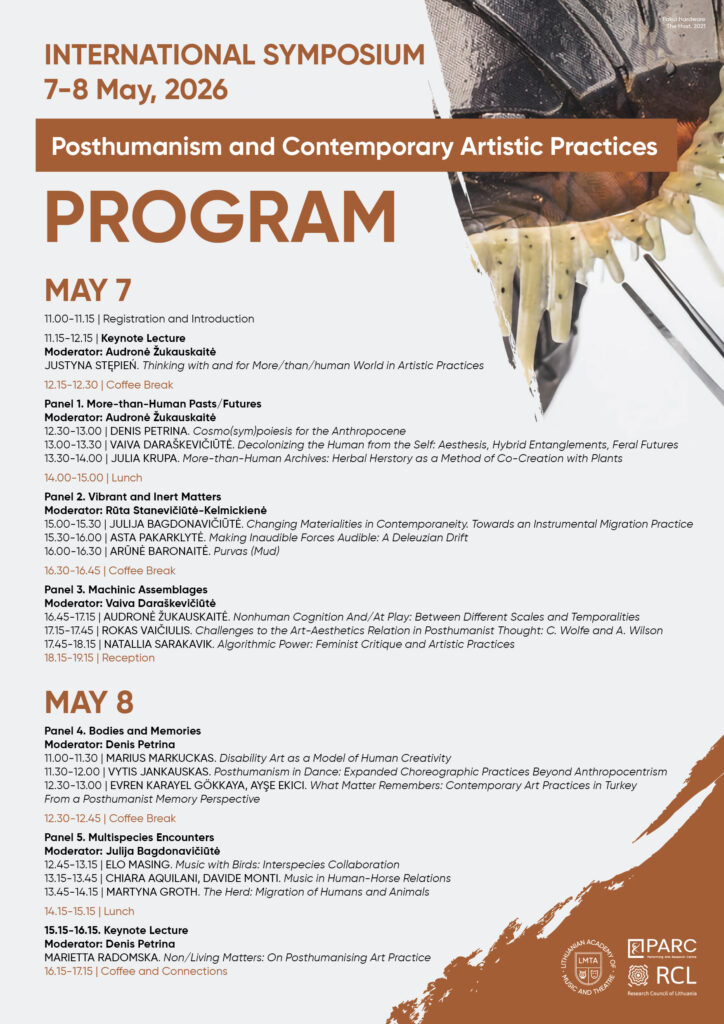
Videos of symposium presentations: